


It is often hard to determine what is influencing Donald Trump one month after the US and Israel's programme of strikes on Iran.
However, it remains apparent he has an eye on the oil markets.
A statement – or social media post – from the US president concerning his plans used to ignite substantial fluctuations in prices, as market participants seized upon indications the hostilities could worsen or de-escalate.
However, in the last week, market players seem to be becoming increasingly doubtful about the value of his pronouncements.
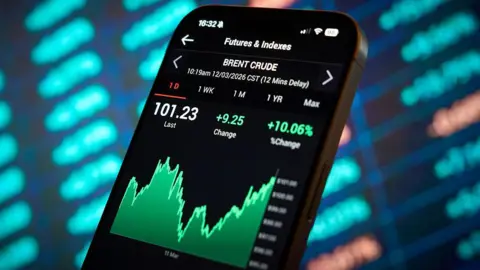
Crude oil was hovering around approximately $72 a barrel (bbl) before 28 February, when the strikes on Iran started.
Recently, it climbed to $118 a barrel on 19 March and by Friday afternoon was sitting at just below $112 – significantly higher than its pre-conflict price.
Here are some moments from the recent weeks where Trump and the financial markets appear to have reacted to each other – with differing impacts.
Navigate with the navigation button to advance to the following chart.
"Energy prices have acted as a barometer for broader geopolitical and economic risks, surging when Trump's rhetoric grows aggressive and easing when his language softens," says one market analyst.
He continues that markets are understandably sensitive to those signals, given the big economic risks that are associated with increasing oil prices.
"Market participants are trying to price real risk," he comments. "The markets can seem skittish or uncertain, but what they're actually doing is navigating geopolitical risk in real time, with oil sitting right at the heart of that."
However, it can be tough for investors to determine how to position themselves, especially since some of Trump's comments appear designed to affecting oil prices, as opposed to communicating official strategy, argues another financial strategist.
"As the saying goes, the first casualty of war is clarity," he remarks. "It is likely much of the communication back-and-forth around successful negotiations, and the opposite, very much are centred around merely moving the price of oil."
Investor Response Become Increasingly Tempered
On Thursday, minutes after US equity markets recorded their largest decline since the start of the conflict with Iran, Trump said talks with Iran were going "extremely well" and he was putting off planned attacks on Iran's oil facilities until at least 6 April.
But, the oil price proceeded to climb.
One market analyst points out that investor responses are "showing less volatility" because of the "huge gap" between Trump's reassurances and the lack of response from Tehran.
"In light of the optics, many market watchers do not foresee an imminent conclusion to the hostilities and financial markets continue to be anxious."
Another market expert notes markets have also adapted to Trump "repeatedly changing tack at indications of geopolitical, equity market or economic trouble".
"There is a amount of doubt, or even downright suspicion, emerging at the edges," he adds.


